
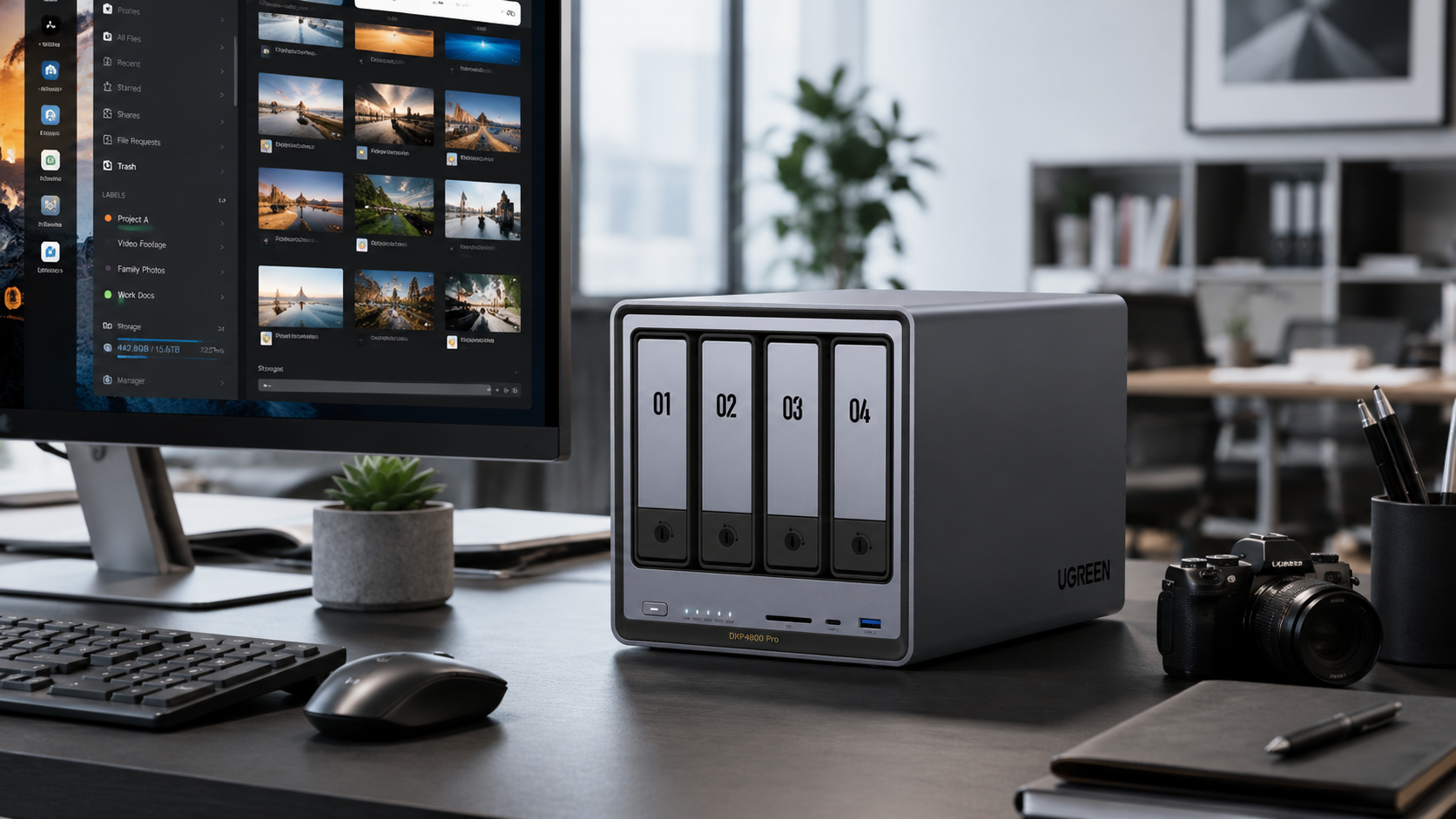
Only 14% of small creators use local AI tools today. That’s why I turned a UGREEN NASync DXP4800 Pro into an AI productivity hub. I wanted a setup that’s always on, keeps my data safe, and speeds up my work without monthly cloud costs.
I picked UGREEN because they offer reliable home office gear. Their storage lineup matched my needs perfectly. The UGREEN NASync DXP4800 was affordable, had the right ports, and was quiet, perfect for my side business.
I’m busy with a full-time job and growing freelance work. I needed a system to host AI tools, automate tasks, and keep files in one place. My aim was to earn more predictably and manage my time better with a NAS I control.
In this project, I focused on five key areas: choosing the right hardware, picking the best software and AI tools, automating workflows, ensuring backups and security, and setting realistic performance goals for creators. I’ll show how to turn a NAS into an AI hub without needing a data center.
Key Takeaways
- Turning a UGREEN NASync DXP4800 into an AI productivity hub offers private, cost-effective automation for creators and small businesses.
- UGREEN hardware is a smart choice for an AI NAS because it’s affordable and easy to use in a home office.
- A local NAS can host AI assistants for tasks like summarizing, tagging files, and creating content on a schedule.
- The project covers tuning hardware, choosing software, automating workflows, and securing backups and data.
- This approach cuts cloud costs, keeps sensitive data safe, and boosts repeatable workflows.
I Turned This UGREEN NASync DXP4800 Into an AI Productivity Hub
I chose UGREEN after trying Synology and QNAP. I wanted something that fit my desk and workflow. UGREEN’s durable, easy-to-use accessories led me to their NAS line. Setting up the UGREEN NAS was easy and fast.
I liked the UGREEN NASync DXP4800 for its compact size and room for drives. It has fast Ethernet and USB ports for backups. This made it a smart storage solution I enjoy daily.
I set achievable goals for my UGREEN NASync DXP4800. It handles file indexing, media libraries, and light AI tasks. It’s great for private knowledge bases and media automation. I can store client files privately and keep backups under control.
My workflow uses local compute and cloud bursts. For big tasks, I use cloud GPUs. For edge tasks, I use the UGREEN NASync DXP4800 device. This approach helps me avoid overreaching with my NAS.
Security was a big concern for me. Running a private hub reduces cloud dependence. I enabled strong passwords, two-factor authentication, and disk encryption. These steps improve privacy without making the system hard to manage.
UGREEN’s ecosystem makes everything work together. Their docking stations, hubs, and power accessories keep things tidy. This setup makes the NAS a welcoming part of my hybrid studio.
In short, the UGREEN NAS AI capabilities are great for creators and entrepreneurs. It’s not a data center, but it’s perfect for everyday AI tasks and growing side businesses.
UGREEN NAS Setup and Hardware Configuration for AI Integration

I’ll show you how I set up the UGREEN NAS for AI. First, I unboxed it and found screws and a screwdriver for the drives. I picked SSDs for speed and HDDs for storage.
Installing the drives was easy. I took off the bottom panel and put in the M.2 drives. Then, I added SSDs for fast access. For the 3.5″ trays, I used the screws and slid them in.
Next, I set it up using the UGREEN NAS app and web UI. The app helped me name the device, create an admin account, and update it automatically. I followed the UGREEN NAS beginner guide for help.
Choosing storage pools was important. I picked RAID 1 for system disks and RAID 5 for more storage. RAID 0 is fast but risky for important data.
Setting up the network was key for speed. I set a static IP, opened ports, and used QoS. Link aggregation and multi-gig Ethernet can also help.
Power and cooling were crucial. I put the NAS in a well-ventilated spot, used a UPS, and set power-saving schedules. This kept it running smoothly for AI tasks.
For heavy tasks, I added a compact Intel NUC and a small GPU. The NAS manages jobs and stores models, while the NUC does the work. This setup balances local and cloud tasks.
Backup and redundancy are essential. I set up automated backups and snapshots for versioning. I tested restores to ensure data safety.
My tips for optimizing the NAS? Label drives and shares, test restores, and measure performance. Adjust your setup based on how you use it. Use the UGREEN resources for more help.
Finally, I tuned the share protocols. I used SMB for Windows, NFS for Linux, and AFP for Macs. These tweaks made the system ready for AI.
Software, AI Tools, and Workflow Automation on the NAS

I set up the UGREEN NAS firmware and added Docker support. This made ai integration with nas safe and easy. I used the web UI to manage containers and monitor logs.
I added productivity apps to turn raw outputs into usable knowledge. I self-hosted Joplin for notes and deployed Weaviate for semantic search. This setup made productivity tools integration feel natural.
Security and resource management matter. I run containers with restricted privileges and enforce CPU and memory limits. I protect web dashboards with SSL and reach the NAS remotely over a VPN for safe control.
For smooth operations, I keep dev and production containers separate and update models during low-use windows. I maintain a simple model registry to track versions and tradeoffs. These practices make ai solutions for nas repeatable and manageable.
I also experimented with an AI assistant integration that indexes new files and answers my queries from the NAS. It became an on-demand support layer for research and content work—an ai productivity hub setup that helps me move faster without losing control.
Conclusion
I aimed to turn a UGREEN NAS into a personal AI productivity center. Step by step, it became key to my side-business. It centralized files, ran services in containers, and automated tasks. This created a solution that reduced hassle and kept my data safe.
The smart setup made it simple to use local models for tasks like transcription and search. This made content creation faster, allowing me to focus on being creative.
The benefits were clear: I saved time on admin tasks and produced content quicker. I also enjoyed better data privacy than cloud tools alone. This boost came from simple automation, not expensive gear. For bigger tasks, I used an edge GPU and cloud bursts to save money without sacrificing performance.
Be realistic about what a consumer NAS can do. It can’t replace a GPU server for big training jobs. Start small and upgrade as you learn. This way, you can turn your NAS into an AI hub without breaking the bank.
I encourage entrepreneurs and professionals to try making a NAS for productivity. Begin with small steps, experiment, and tailor the AI integration to your needs. Done right, a NAS can be a game-changer, boosting productivity and supporting your financial and creative goals.


Leave a Reply